
How Much Does Custom Software Cost in the Philippines? (2026 Guide)
Transparent breakdown of custom software development costs in the Philippines in 2026 — from MVP to enterprise build — so you can budget with confidence.

What Does Custom Software Actually Cost in the Philippines?
Custom software in the Philippines typically costs between ₱300,000 and ₱5,000,000 (roughly $5,000 to $87,000 USD) depending on scope, complexity, and the team you hire. A simple MVP with core features sits on the lower end; a multi-module enterprise platform with integrations, mobile apps, and ongoing maintenance sits on the upper end. The wide range isn't evasion — it reflects genuine variation in what "custom software" means from one business to the next.
This guide breaks down every cost component with real numbers, explains what drives the price up or down, and gives you a framework for building a defensible budget before you talk to a single developer.
The Cost Spectrum: Project Types and Ranges
Before diving into components, here's a reference table mapping project types to typical ranges for Philippine-built software.
| Project Type | Typical Range (PHP) | Typical Range (USD) | Timeline |
|---|---|---|---|
| Landing page / marketing site | ₱30,000 – ₱80,000 | $500 – $1,400 | 2–4 weeks |
| MVP (core feature set only) | ₱300,000 – ₱700,000 | $5,200 – $12,200 | 6–12 weeks |
| Internal tool / admin portal | ₱250,000 – ₱600,000 | $4,300 – $10,500 | 6–10 weeks |
| Customer-facing web application | ₱600,000 – ₱1,800,000 | $10,500 – $31,500 | 12–20 weeks |
| Mobile app (iOS + Android) | ₱700,000 – ₱2,000,000 | $12,200 – $35,000 | 14–24 weeks |
| ERP / operations platform | ₱1,500,000 – ₱5,000,000+ | $26,000 – $87,000+ | 24–52 weeks |
| AI-integrated platform | ₱800,000 – ₱3,000,000 | $14,000 – $52,500 | 16–36 weeks |
These ranges assume a competent local studio or freelance team. They do not include ongoing hosting, maintenance retainers, or future feature development.
Philippine Developer Rate Cards (2026)
The core input into any software project cost is developer time. Here's what you're actually paying for when you hire in the Philippines.
Freelance Rates (Direct Hire)
| Role | Monthly Rate (PHP) | Hourly Equivalent |
|---|---|---|
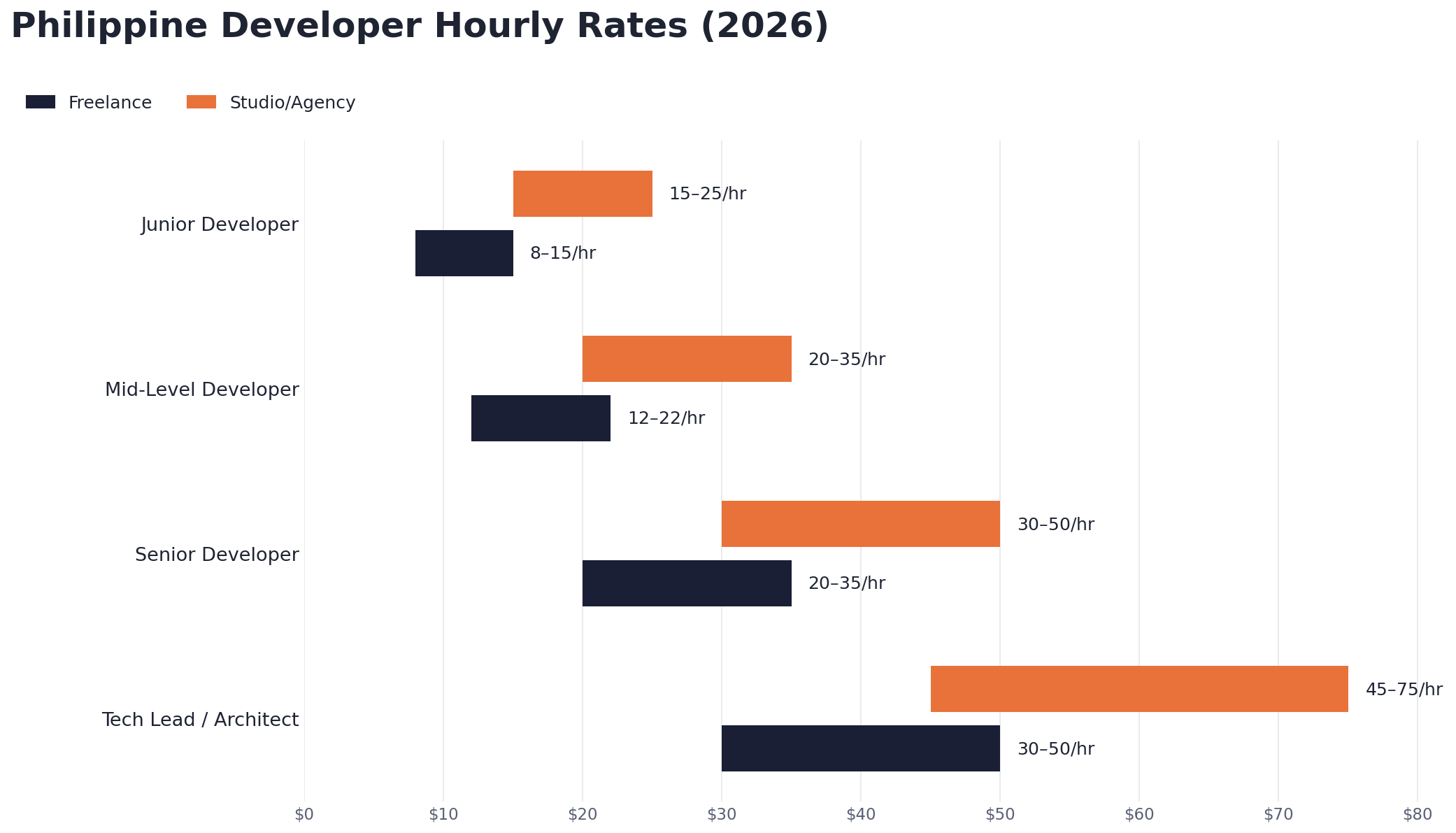
| Junior developer (0–2 yrs) | ₱25,000 – ₱45,000 | ₱150 – ₱270/hr |
| Mid-level developer (2–5 yrs) | ₱50,000 – ₱85,000 | ₱300 – ₱510/hr |
| Senior developer (5+ yrs) | ₱90,000 – ₱150,000 | ₱540 – ₱900/hr |
| UI/UX designer | ₱40,000 – ₱90,000 | ₱240 – ₱540/hr |
| Project manager | ₱55,000 – ₱100,000 | ₱330 – ₱600/hr |
Studio / Agency Rates
Studios charge a blended rate that covers developers, management overhead, QA, and administrative costs. In 2026, Philippine software studios typically bill between ₱2,000 and ₱5,000 per hour ($35–$87 USD) depending on the firm's track record and specialization.
At StackSpace, our projects are scoped by deliverable rather than pure hourly billing — we find this aligns incentives better for both sides. But the hourly equivalent gives you a useful comparison baseline.
Why the Studio Premium Exists
Hiring three freelancers at lower individual rates sounds cheaper than a studio. In practice, you're also taking on:
- Coordination overhead between contractors
- No single point of accountability for the outcome
- Risk of knowledge concentration in one person who might leave mid-project
- No QA layer unless you explicitly hire for it
The studio premium buys you a team that has already worked together, a process that catches errors before they reach you, and someone who answers for the result end to end.
The Five Cost Components of Any Software Project
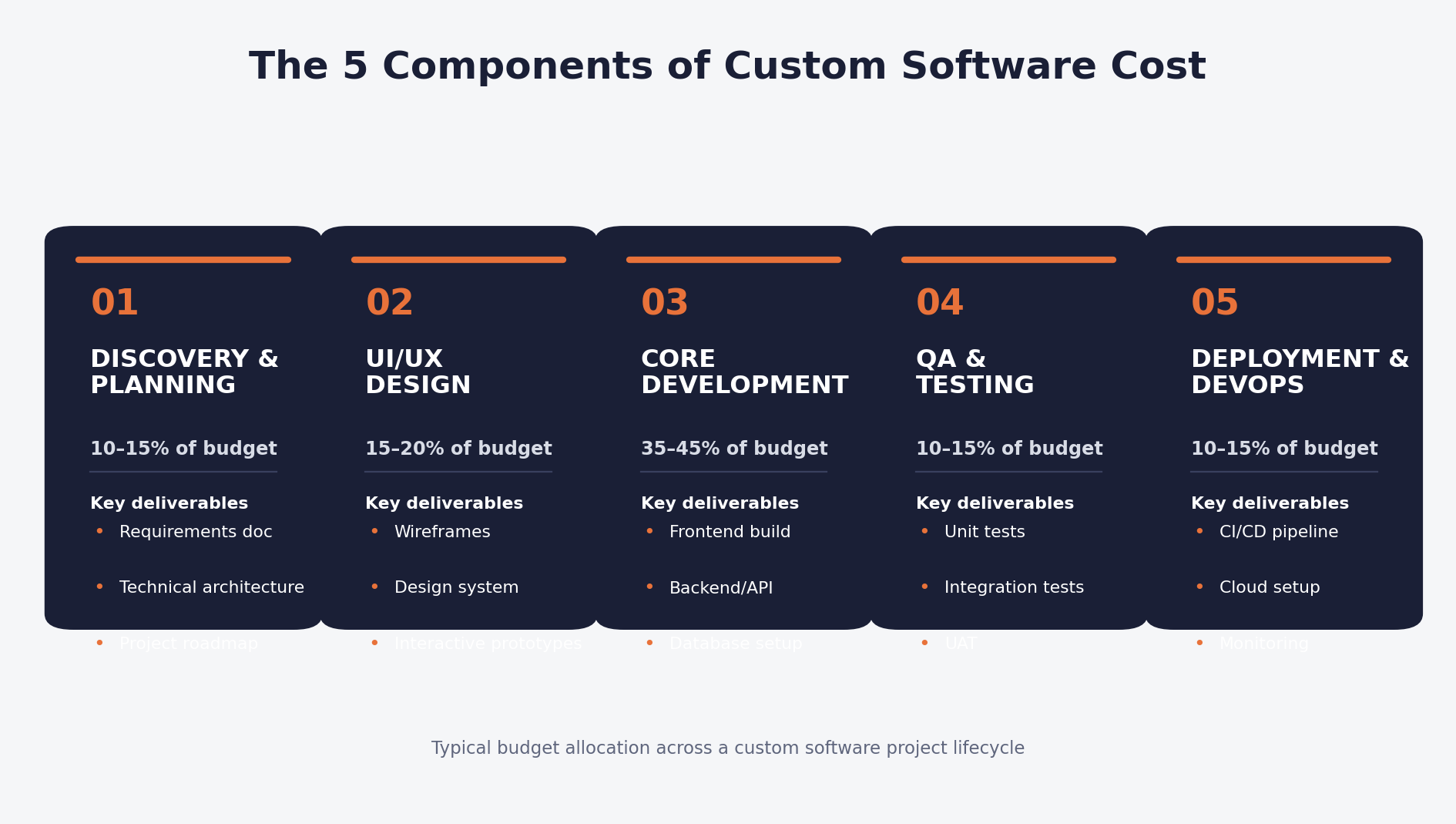
Custom software costs aren't a single line item. Every serious quote should break down these five components explicitly.
1. Discovery and Architecture (10–15% of total budget)
Before writing a line of code, someone needs to translate your business requirements into a technical specification. This phase covers:
- Requirements gathering and stakeholder interviews
- User flow mapping and wireframing
- Technology stack selection
- Database schema design
- Integration architecture (third-party APIs, payment gateways, etc.)
- Technical feasibility assessment
Skipping or underfunding this phase is the single biggest predictor of project failure. We've seen projects that skipped discovery spend 3x as much fixing architectural decisions that could have been avoided with four weeks of upfront planning.
Budget: ₱50,000 – ₱300,000 depending on project complexity.
2. UI/UX Design (15–20% of total budget)
Design is not decoration — it's the specification for what gets built. The deliverable is typically:
- High-fidelity wireframes
- Interactive prototypes
- Component library / design system
- Mobile-responsive layouts
- Accessibility compliance documentation
Philippine design talent is strong. You can get excellent UI/UX work from local designers at rates well below what the same quality costs in North America or Europe. The risk is in underfunding this stage to save money — a beautiful-looking design in Figma that hasn't been stress-tested against real user flows will generate expensive rework during development.
Budget: ₱80,000 – ₱500,000 for a full application design.
3. Development (55–65% of total budget)
This is the largest cost center and where most of the rate-card math applies. Development costs break down further by layer:
Frontend development (what users see and interact with): React, Next.js, Vue, or Flutter depending on whether it's web or mobile. Expect 40–50% of total dev hours.
Backend development (business logic, data processing, APIs): Node.js, Python/Django, or similar. Another 40–50% of dev hours.
Integrations (payment gateways, CRMs, third-party APIs, SMS providers): Often underestimated. Every API integration has its own quirks, rate limits, and documentation gaps. Budget 1–3 weeks per major integration.
Infrastructure setup (cloud servers, databases, CI/CD pipelines, monitoring): Usually 1–2 weeks for a well-configured production environment. Don't skip this in favor of a quick deploy — it costs more to fix later.
4. Quality Assurance (10–15% of total budget)
Testing is where Philippine software projects most commonly cut corners, and where it hurts most visibly. A proper QA phase includes:
- Functional testing (does every feature work as specified?)
- Integration testing (do the pieces work together?)
- Performance testing (does it hold up under realistic load?)
- Security testing (are there obvious vulnerabilities?)
- User acceptance testing (does it solve the actual business problem?)
Budget 10–15% of your total project cost for QA. If a quote doesn't include this as a separate line item, ask where it's hidden — or assume it isn't there.
5. Deployment and Handover (5–10% of total budget)
Getting software into production and transferring knowledge is a phase in itself:
- Production environment setup
- Data migration (if replacing an existing system)
- Team training and documentation
- Performance optimization and load testing
- Bug fixes from initial production use
- Handover documentation
Budget: ₱30,000 – ₱150,000 depending on the complexity of the handover.
What Drives Costs Up
The ranges above are starting points. Here's what pushes a project toward the top of the range — or beyond it.
Complex integrations. Every third-party system you need to connect adds cost. Payment gateways, logistics APIs, government systems (BIR, DOLE compliance modules), banking integrations — each one requires its own implementation work, testing, and ongoing maintenance.
Regulatory compliance requirements. Certain industries — healthcare, fintech, legal — have compliance requirements that add significant development overhead. PDPA (Philippine Data Privacy Act) compliance, for example, affects data architecture decisions from the ground up.
Custom AI features. Embedding machine learning models, large language model integrations, or AI-powered recommendation systems adds both development cost and ongoing API/inference costs. See our guide to AI agents in business operations for a sense of what's realistic.
Real-time functionality. Chat systems, live dashboards, collaborative editing, push notifications — anything requiring real-time data adds architectural complexity and therefore cost.
Multi-tenancy. If you're building a SaaS platform where multiple clients share the infrastructure with data isolation, the architecture is significantly more complex than a single-tenant application.
Tight timelines. Compressing a 20-week project into 12 weeks typically means adding more developers — but coordination costs rise with team size, and there's a ceiling on how much parallelization helps. Expect a 20–40% premium for aggressive timelines.
What Keeps Costs Down
Equally important: here's what actually reduces costs without sacrificing quality.
Well-scoped requirements. The clearest predictor of budget overruns is scope ambiguity. The more precisely you can specify what the software needs to do — with explicit examples, edge cases defined, and non-goals documented — the more accurate the quote and the fewer expensive "but I thought it would also..." conversations happen mid-project.
Using existing components. Most business applications share 60–70% of the same functionality: authentication, user management, notifications, file uploads, reporting. Studios that have built these before — and have reusable components for them — can deliver faster and cheaper than one-off builds.
Starting with an MVP. Rather than building everything upfront, a disciplined MVP scope focuses on the features that prove the core value of the software. Build, test with real users, then invest in expansion. We cover this in depth in our post on why Philippine startups are choosing custom software.
Offshore talent for non-core work. Certain development tasks — automated testing, documentation, basic CRUD interfaces — can be handled by junior developers at lower rates without affecting quality. A good studio already structures its team this way.
Ongoing Costs After Launch
The build cost is only part of the picture. Software requires ongoing investment to stay secure, functional, and relevant.
| Cost Category | Typical Monthly Range |
|---|---|
| Hosting (cloud infrastructure) | ₱5,000 – ₱50,000 |
| Maintenance retainer (bug fixes, security patches) | ₱25,000 – ₱80,000 |
| Feature development (new functionality) | ₱80,000 – ₱300,000+ |
| Third-party API costs (payments, SMS, AI) | Varies by usage |
| SSL, domain, monitoring tools | ₱2,000 – ₱10,000 |
A rough rule: budget 15–20% of the initial build cost per year for maintenance and minor improvements. A ₱1,000,000 application should have an annual maintenance budget of ₱150,000–₱200,000.
For a more complete breakdown of total cost of ownership, see our post on the true cost of building a custom web application.
Philippine vs. Offshore: A Cost Comparison
One question we get regularly: why not just hire a team in India, Eastern Europe, or Latin America? The honest answer is that it depends on what you're optimizing for.
| Factor | Philippine Studio | Indian Studio | Eastern European Studio | Latin America | US / Canada / Australia |
|---|---|---|---|---|---|
| Hourly rate | $25–$50 USD | $20–$40 USD | $50–$90 USD | $35–$60 USD | $90–$175 USD |
| Time zone (vs. Manila) | Same | -2.5 hrs | -6 to -7 hrs | -11 to -15 hrs | -3 to -17 hrs |
| English proficiency | Very high | High | Moderate–high | Moderate–high | Native |
| Cultural alignment | Strong (US/PH market) | Neutral | Neutral | Neutral | Native |
| Revision communication | Same-day | Next-day | Same-day | Same-day | Same-day |
| Local market knowledge | Excellent | Limited | Limited | Limited | N/A |
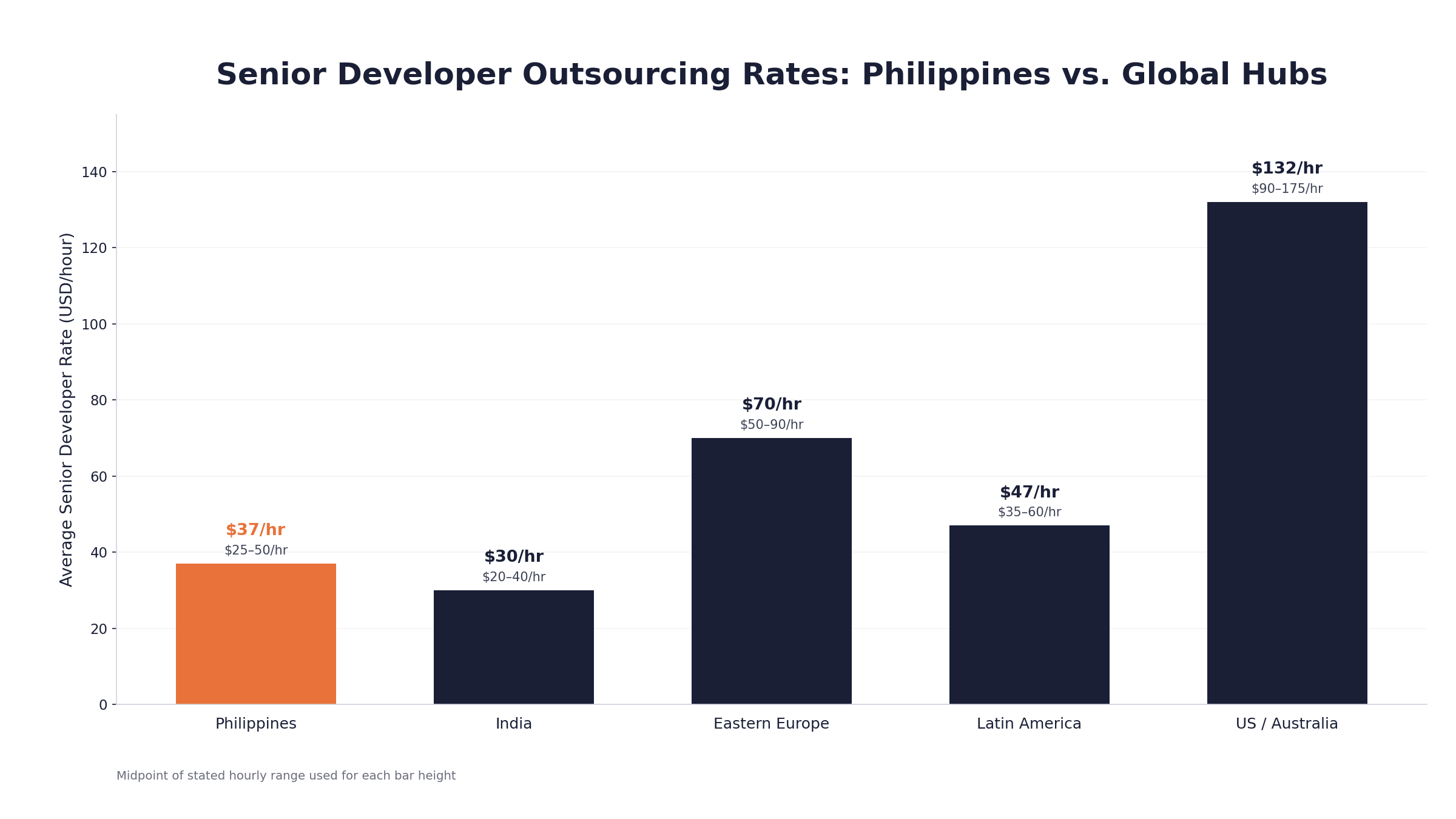
For Philippine businesses building software for Philippine users — with local payment gateways, local compliance requirements, and local market nuances — the coordination overhead of offshore development often offsets the rate difference. We've taken over several projects from offshore vendors where local context issues caused months of rework.
That said, pure rate arbitrage is real. If you're building a general-purpose B2B SaaS with no local market specifics, offshore can work well with the right project management structure.
Frequently Asked Questions
How much does it cost to build an app in the Philippines?
A basic mobile app (iOS and Android) typically costs ₱700,000–₱2,000,000 depending on features. A simple information app with user authentication and basic content sits near the lower end; a marketplace or transaction-based app with real-time features sits near the upper end.
Is it cheaper to hire a freelancer or a software agency in the Philippines?
Individual freelancers cost less per hour, but the total project cost is often comparable because agencies include project management, QA, and coordination that you'd otherwise need to provide yourself. For projects under ₱300,000, a freelancer may be sufficient. Above that threshold, the risk profile of a team with no unified accountability usually isn't worth the hourly savings.
What is the average software development rate in Manila?
Mid-level developers in Manila bill between ₱50,000–₱85,000 per month as freelancers, or ₱300–₱510 per hour. Studio blended rates in Manila run ₱2,000–₱5,000 per hour depending on the firm and project type.
How long does it take to build custom software in the Philippines?
Timeline depends heavily on scope. A focused MVP takes 6–12 weeks. A full customer-facing web application with multiple user roles and integrations takes 12–20 weeks. Enterprise platforms with complex workflows can take 6–12 months. These timelines assume a full-time dedicated team — not a part-time freelancer juggling multiple clients.
Why do software projects go over budget?
The most common causes are: scope creep (features added after requirements were agreed), underspecified requirements that require rework, integration complexity that was underestimated, and insufficient QA that pushes bug fixing into post-launch where it's more expensive to fix. A solid discovery phase and written requirements document prevent most of these.
Does StackSpace offer fixed-price projects?
Yes. We scope projects in detail during discovery, then provide fixed-price quotes for the agreed scope. Changes outside scope are handled through a transparent change-order process. This protects both sides — you know your budget exposure, and we're not absorbing scope creep without acknowledgment. Reach out via our custom software development page to start a conversation.
Building Your Budget: A Practical Framework
Here's how to turn the information above into a number you can actually take to leadership or investors.
Step 1 — Define the core user workflows. List the 5–10 things your software must do on day one to deliver value. These are your MVP features.
Step 2 — Identify your integration requirements. List every external system the software needs to connect with: payment providers, existing databases, third-party APIs, communication platforms.
Step 3 — Apply the cost structure. Use 15% for discovery, 15% for design, 60% for development, 10% for QA as your starting allocation. Use the rate tables above to estimate development hours.
Step 4 — Add a contingency buffer. First-time builds almost always surface unforeseen complexity. A 20% contingency budget is appropriate for most projects.
Step 5 — Model ongoing costs. Add 15–20% of the build cost annually for maintenance. Add hosting and API costs based on expected usage.
Step 6 — Get two or three quotes. Don't evaluate on price alone. Ask how the team handled scope changes on a previous project, request references, and look at the quality of their past work. The cheapest quote is rarely the cheapest outcome.
Final Thoughts
Custom software in the Philippines offers genuine value for businesses that need solutions beyond what off-the-shelf tools can provide. The rate environment is favorable compared to North America or Europe, the talent pool in Metro Manila is deep, and local developers bring context that offshore vendors simply don't have.
The businesses that get the best outcomes are the ones that invest in proper scoping, treat the discovery phase seriously, and budget for ongoing maintenance rather than treating the build as a one-time cost. Software is not a product you buy once — it's a capability you develop and maintain over time.
If you're planning a custom software project and want a straight conversation about what it would actually cost for your specific use case, start the conversation with us. No boilerplate quotes — just a realistic scope and a number you can plan around.
Written by
Jabez Borja
More articles
How to Evaluate If Your Business Is Ready for AI Automation
A practical AI readiness assessment for business owners — the five dimensions that decide whether automation will pay off, a self-scoring scorecard, a step-by-step assessment process, and the green lights and red flags to check before you build.
Hidden Costs of Software Development Nobody Warns You About
The line items that don't show up in a software quote but blow up the budget anyway — maintenance, infrastructure, scope creep, integrations, and more. A 2026 breakdown with realistic ranges and a pre-signature checklist.
Our Tech Stack for Building Client Projects in 2026: Tools, Infra, and Why
A transparent look at the tech stack StackSpace uses to build client projects in 2026 — the frontend, backend, database, infrastructure, and AI tools we default to, the criteria we choose them on, and where we deliberately deviate.
Want to build something?
We help businesses turn ideas into production software. Book a discovery call and let's talk about your project.