
Next.js vs React Native vs Flutter: How to Choose Your Stack in 2026
A practical 2026 comparison of Next.js, React Native, and Flutter — with current market share, real performance benchmarks, hiring economics, and a step-by-step framework for picking the right stack.

Which Stack Should You Pick: Next.js, React Native, or Flutter?
Pick Next.js if your product lives on the web and SEO, fast initial loads, or content discoverability matter. Pick React Native if you need a mobile app, your team already writes React, and you value hiring depth and over-the-air updates. Pick Flutter if you need pixel-perfect UI parity across iOS, Android, web, and desktop from a single codebase — especially for animation-heavy or brand-driven experiences. The wrong choice doesn't just slow you down; it locks you into rebuilds 18 months later.
This guide walks through what each framework actually is in 2026, how they compare on the dimensions that matter, and a step-by-step process to make the call without regret.
What Each Stack Actually Is in 2026
Before the comparison, a clean definition of each — because the marketing copy has gotten muddy.
Next.js
Next.js is a React-based web framework maintained by Vercel that handles server-side rendering, static generation, routing, image optimization, and API endpoints in one integrated package. As of 2026, it ships with stable Turbopack (a Rust-based bundler), React Server Components, Server Actions, and a static route indicator. Turbopack delivers up to 53% faster development startup versus Webpack and HMR updates in milliseconds regardless of project size.
It powers roughly 1.5% of all websites tracked on the public web and holds an 11.6% share of frontend frameworks, with notable users including Amazon, IBM, and McDonald's. Next.js is a web framework — full stop. It does not produce native iOS or Android binaries.
React Native
React Native is a framework from Meta for building native mobile apps using JavaScript and React. In 2026, the New Architecture — JSI, Fabric, and TurboModules — is the default. Version 0.82 marks the end-of-life for the old bridge architecture (March 2026), and 0.84 makes Fabric the default renderer. Hermes is the required JavaScript engine, providing ahead-of-time bytecode compilation.
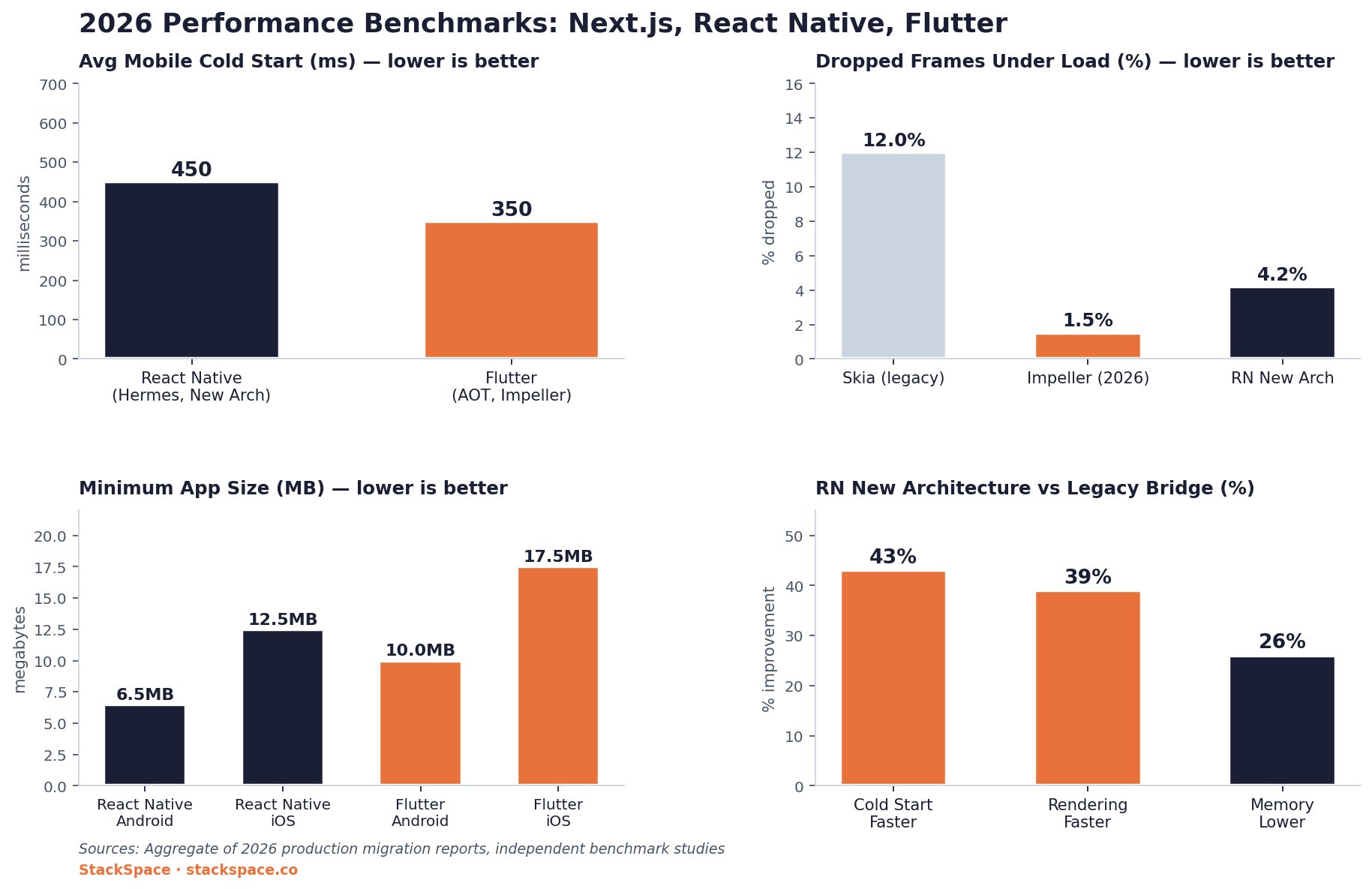
Real production migrations to the New Architecture report 43% faster cold starts, 39% faster rendering, and 26% lower memory usage compared to the legacy bridge. Apps built with React Native compile to true native components — the buttons you tap are real UIButton and android.widget.Button instances, not pixel-painted approximations.
Flutter
Flutter is Google's UI toolkit for building applications across iOS, Android, web, Windows, macOS, and Linux from a single Dart codebase. In 2026, it ships with Impeller as the default rendering engine on iOS and on Android API 29+ — replacing the older Skia engine. Impeller is an ahead-of-time-compiled renderer that eliminated the long-standing shader compilation jank that plagued earlier versions.
Independent benchmarks show Impeller delivers a 30–50% reduction in jank frames during complex animations, 120 FPS on high-refresh displays, and uses approximately 100MB less memory than the previous engine. Flutter renders its own UI pixel-by-pixel rather than using platform-native widgets — which is both its biggest strength (perfect cross-platform consistency) and its biggest tradeoff (no platform-native feel by default).
The Cross-Platform Mobile Market in 2026
If you're choosing between React Native and Flutter, the market has clearly shifted. Three years ago React Native held a comfortable lead. Today the picture is different.
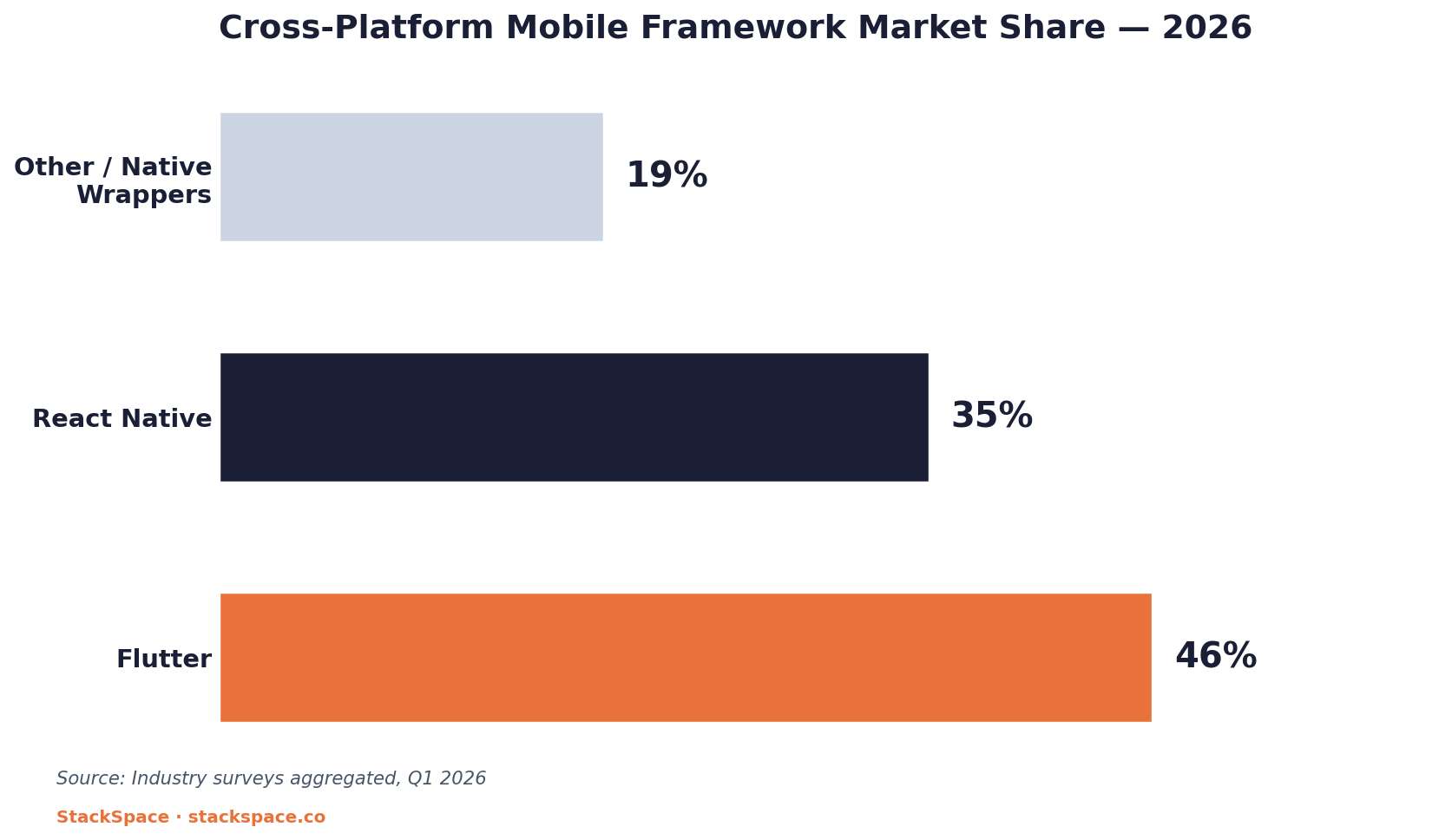
Flutter now holds approximately 46% of the cross-platform market share, compared to React Native's 35%. The gap closed primarily because Flutter shipped Impeller, expanded to web and desktop as stable targets, and earned enterprise adoption from Google Pay, BMW, Toyota, Alibaba's Xianyu marketplace (200M+ users), and Nubank (Latin America's largest digital bank, 90M+ customers).
That said, market share isn't the same as the right choice for your project. React Native's hiring pool is still substantially larger — Q1 2026 LinkedIn and Indeed data show roughly 8x more React Native developer listings than Flutter positions in the US.
Direct Comparison: Next.js vs React Native vs Flutter
Here's how the three stack up on the dimensions that actually drive a decision.
| Dimension | Next.js | React Native | Flutter |
|---|---|---|---|
| Primary use case | Web apps, SaaS, marketing sites | Native iOS + Android apps | iOS, Android, web, desktop |
| Language | TypeScript / JavaScript | TypeScript / JavaScript | Dart |
| UI rendering | Browser DOM (HTML/CSS) | Platform-native widgets | Custom Skia/Impeller engine |
| App store distribution | No (web only) | Yes | Yes |
| SEO out of the box | Excellent (SSR/SSG) | Not applicable | Limited (web target) |
| Avg cold start (mobile) | N/A | 300–600ms (Hermes) | 200–500ms (AOT) |
| App size baseline | N/A | 5–8MB Android / 10–15MB iOS | 8–12MB Android / 15–20MB iOS |
| UI consistency across OS | Web: yes. Native: N/A | Differs by platform | Pixel-perfect identical |
| Hot reload | Yes (millisecond HMR) | Yes (Fast Refresh) | Yes (sub-second) |
| Over-the-air updates | Built-in (web is OTA) | Yes (Expo / CodePush) | Limited (Shorebird, paid) |
| Talent pool (relative) | Very large | Large (8x Flutter in US) | Medium, growing |
| Median dev salary (US, 2026) | $120K–$140K | $122K | $138K |
| Web support | Native target | Limited (Expo Web) | Stable, but not SEO-friendly |
| Backed by | Vercel | Meta |
The takeaway: these aren't competing technologies — they target different problems. The mistake teams make is trying to use one of them for what another is built to do.
Performance: What the 2026 Benchmarks Actually Show
Performance comparisons get oversimplified in most blog posts. Here's the honest picture for production apps in 2026.
Mobile Frame Rendering
In animation-heavy scenarios — parallax scrolling, complex transitions, particle effects — Flutter consistently hits 60fps where React Native occasionally drops to 52–58fps. On 120Hz displays, Flutter holds 120 FPS reliably with Impeller. Real-world testing shows 12% dropped frames on Skia versus just 1.5% with Impeller under load.
For typical business apps — forms, lists, navigation, modals — neither user nor stakeholder will notice a difference. The performance gap matters in games, pro creative tools, and graphics-rich consumer apps. It rarely matters in a B2B mobile workflow tool.
Mobile Cold Start
Hermes-powered React Native apps start in 300–600ms when properly optimized. Flutter's AOT compilation gives it a slight edge at 200–500ms. The New Architecture migration in React Native 0.84 closed much of the historical startup gap.
Web Performance (Next.js Only)
For server-rendered React applications, Next.js with Turbopack and React Server Components delivers Largest Contentful Paint times that are competitive with hand-tuned static sites. Server Components dramatically reduce the JavaScript shipped to the browser — pages that previously sent 400KB of JS now ship 60–80KB for the same rendered output. This translates directly into Core Web Vitals scores and search rankings.
Memory Footprint
Impeller uses approximately 100MB less RAM than the previous Flutter rendering engine under sustained UI load. React Native's New Architecture reports 26% lower memory usage than the legacy bridge in production migrations. Both are acceptable for modern devices, but on low-end Android (which is most of Southeast Asia's market), the optimizations matter.
How to Choose Your Stack: A 5-Step Framework
This is the framework we use at StackSpace when scoping a new project. Walk through it before talking to any developer.
Step 1: List Your Distribution Channels
Where does the user actually access your product?
- Web only (browser, no install): Next.js wins. Don't overcomplicate this.
- Mobile only (iOS + Android, no marketing site): React Native or Flutter.
- Both web and mobile: Next.js for the web product + React Native or Flutter for mobile. Treat them as two products that share an API, not as one codebase that targets everything.
- Web, mobile, and desktop: Flutter is the only realistic single-codebase path. Otherwise, accept that you're building two-to-three apps.
A common mistake: trying to use Flutter Web as your primary website. Flutter renders to canvas, which means the content isn't crawlable by search engines the way HTML is. If SEO matters, Flutter Web is wrong for that surface.
Step 2: Audit Your Engineering Team
Talent availability shapes the decision more than anything else.
- Existing React team: Default to Next.js for web and React Native for mobile. Onboarding cost is near zero.
- No engineers yet, hiring in major US/EU cities: React Native talent is 5–8x more abundant than Flutter; you'll hire faster.
- No engineers yet, hiring in the Philippines or Southeast Asia: The local Flutter community is strong (we cover this in our Philippine developer rates guide). Both work.
- Existing Dart or strong typed-language team: Flutter is a comfortable fit and you'll get better-than-average results.
- Existing native iOS/Android team: You're probably not the target audience for cross-platform — but if you must consolidate, React Native lets your native engineers continue writing native modules where it matters.
Step 3: Define Your Performance and UX Profile
Most apps don't need maximum performance. Some absolutely do.
- Standard CRUD app, dashboards, forms, content: All three work. Pick on team and ecosystem.
- Animation-heavy or brand-defining UI: Flutter. Impeller's rendering and the widget catalog give you cinematic UX with reasonable effort.
- Heavy reliance on platform-native components and OS look-and-feel: React Native. Tabs feel like iOS tabs. Lists feel like Android lists.
- Real-time, low-latency interactions (chat, collaborative editing, live data): All three handle this — but Next.js with WebSockets or React Server Components has the lowest infra complexity for web; React Native and Flutter both handle native WebSocket clients well.
- Heavy graphics, AR/VR, or game-adjacent: None of these. Use a native stack or a game engine.
Step 4: Estimate Cost and Timeline
Cross-platform saves money, but not as much as the marketing claims.
A typical breakdown for a mobile app with parity on iOS and Android:
- Two native apps (Swift + Kotlin): 100% baseline cost
- React Native or Flutter (single team): 55–70% of baseline
- Next.js + Capacitor (web + wrapped native): 35–50% of baseline, but with native UX limitations
Flutter projects tend to ship MVPs 10–20% faster than equivalent React Native projects because of the rich widget catalog — you spend less time hunting for libraries that match your design. React Native projects benefit from the larger npm ecosystem when integrating with non-trivial third-party services.
For Philippine-based teams, mobile MVP costs typically run ₱700,000–₱2,000,000 ($12,000–$35,000 USD) for either framework. For more on regional pricing, see our custom software cost guide for the Philippines.
Step 5: Plan for Year Two
The cheapest decision today is not always the cheapest decision over three years. Consider:
- Will you need to add a new platform? Web-bolted-on-later projects almost always rebuild. If web is even possible in your roadmap, plan for it now.
- Who maintains this in 18 months? A Flutter app with one Dart engineer at your company is a single point of failure if that person leaves and Flutter talent is scarce in your area.
- How critical are OTA updates? If you push fixes weekly, React Native with Expo Updates or CodePush has the best ergonomics. Flutter's OTA story is paid (Shorebird) and less mature.
- Will the UI evolve significantly? Flutter's widget composability holds up well for ambitious redesigns. React Native's reliance on platform components can fight you when you want a non-standard look.
Real-World Scenarios: What We'd Actually Recommend
Generic frameworks don't help when you're staring at a real product spec. Here's how the decision plays out in scenarios we see weekly.
Scenario 1: B2B SaaS with Marketing Site + In-App Tool
Pick: Next.js for everything.
A B2B SaaS doesn't need a native mobile app for v1. The marketing site, login, dashboard, and admin panel all live in the browser. Next.js gives you SSR for SEO on the marketing pages, server components for fast dashboards, and one codebase to maintain. Add a native app later if mobile usage becomes a real constraint — most B2B products never need it.
Scenario 2: Consumer Mobile App with Significant Web Presence
Pick: Next.js for web, React Native (with Expo) for mobile.
Your users discover you through Google, sign up on the web, and use the mobile app daily. Next.js handles the marketing site, blog, and signup flow. React Native delivers the mobile experience and shares your business logic via a separate package. Skip Flutter Web here — you don't want your marketing site rendered to canvas.
Scenario 3: Visual-First Consumer App (Brand, Animation, Cross-Platform)
Pick: Flutter.
Think Duolingo-style streaks, complex onboarding animations, custom illustrations, and a need to look identical on every device. Flutter's widget system and Impeller renderer are built for this. The cost is fewer platform-native conventions, but for brand-led apps that's actually a feature.
Scenario 4: Enterprise Internal Tool with iOS-First Field Workforce
Pick: React Native.
Field workers expect platform-native conventions — iOS swipe gestures, share sheets, push notifications that integrate with system settings. React Native uses platform-native components, gives you a faster path to native modules when you need them, and your existing React backend team can contribute. We use this stack for several of our field operations apps.
Scenario 5: Internal Admin / Operations Dashboard
Pick: Next.js.
Internal tools rarely need mobile native. Browser is fine. Next.js with React Server Components keeps the JS bundle tiny and server data access trivial. We build most of our internal tools on this stack.
Common Mistakes Teams Make
We see the same wrong-stack decisions repeatedly. Avoid these.
Building the marketing site in Flutter Web. Search engines can't crawl canvas-rendered content the way they crawl HTML. Your SEO will be measurably worse. Use Next.js for any surface where organic traffic matters.
Choosing React Native because "we know JavaScript" — for a graphics-heavy app. If your product is animation-driven or visually ambitious, you'll fight React Native's platform-native rendering for months. Flutter would have shipped faster.
Choosing Flutter because the demos look great — and ignoring hiring. A pretty MVP that you can't staff in year two is a liability. Audit your local talent market before committing.
Sharing a "single codebase" across web and mobile in React Native or Flutter. It's possible. It's almost never a good idea. Web and mobile have different navigation patterns, different input expectations, and different layout constraints. Code sharing works at the API and business logic layer — not at the UI layer.
Skipping the New Architecture migration in React Native. If you're starting a new RN project in 2026, you must enable the New Architecture from day one. The legacy bridge is end-of-life. Starting on the old arch means a forced rewrite within a release cycle.
Frequently Asked Questions
Is Flutter better than React Native in 2026?
Flutter has a slight edge on raw rendering performance and cross-platform UI consistency in 2026, while React Native has a larger talent pool and stronger over-the-air update story. Neither is "better" universally — Flutter wins for animation-heavy, brand-driven apps; React Native wins when you need platform-native UX, OTA agility, or your team already writes React. Both are production-ready and backed by major companies.
Can Next.js replace React Native for mobile apps?
No. Next.js is a web framework — it does not produce native iOS or Android binaries. You can wrap a Next.js application with Capacitor or Tauri to ship it to app stores, but the result is a web view inside a native shell, not a true native app. For most B2B tools that's acceptable. For consumer apps where performance and platform feel matter, you need React Native or Flutter.
What's the cheapest stack for a mobile app in the Philippines?
Both React Native and Flutter mobile MVPs typically cost ₱700,000–₱2,000,000 ($12,000–$35,000 USD) when built by a competent local studio. Flutter projects ship 10–20% faster on average due to its widget catalog, while React Native projects benefit from the broader npm ecosystem. The bigger cost driver is scope, not framework choice. See our Philippine custom software cost breakdown for full pricing detail.
Should I use Next.js with Capacitor instead of React Native?
For a Next.js team building a mobile app where UX is acceptable but not exceptional, yes — it's a legitimate cost-saver. The tradeoff: it feels like a web app inside a native shell because that's exactly what it is. Animations are less smooth, gestures are less native, and integrating deep platform features (Live Activities, Widgets, Watch apps) requires writing native code anyway. If your product needs to feel like a polished mobile app, build it with React Native or Flutter.
Does Flutter still have shader compilation jank in 2026?
No. The Impeller rendering engine — default on iOS and Android API 29+ in 2026 — uses ahead-of-time shader compilation, eliminating the long-standing jank issue from earlier Flutter versions. Independent benchmarks measure dropped frames at 1.5% on Impeller versus 12% on the older Skia engine for the same workload.
Will React Native's New Architecture break my existing app?
Apps using the legacy bridge architecture will work through React Native 0.81. Version 0.82 marks the old architecture's end-of-life (March 2026), and 0.84 makes Fabric the default. Migration is required. Most third-party libraries in active maintenance now support the New Architecture. The performance upside is real — production migrations report 43% faster cold starts and 26% lower memory usage — but plan for one to two engineering weeks of migration work depending on app size and library count.
How do I decide if I need Flutter Web?
Use Flutter Web only if you already have a Flutter mobile app and you need a web companion that exactly mirrors the mobile UI — usually for an internal tool, a portfolio, or a product demo. Do not use Flutter Web as your primary, public-facing website. The canvas-based rendering hurts SEO, accessibility, and initial load time compared to Next.js or any HTML-first framework.
Final Thoughts
There's no universally correct answer to Next.js vs React Native vs Flutter — but there is a correct answer for your specific product, team, and timeline. The framework that ships your MVP in 12 weeks and survives the next 36 months without a rewrite is the right one.
The decision usually breaks like this in 2026:
- Web product → Next.js, every time.
- Mobile product, React-heavy team → React Native with the New Architecture and Expo.
- Mobile product, brand-driven UI, multiple platforms → Flutter with Impeller.
- Trying to do all three from one codebase → don't. Build two products that share an API.
If you're in the middle of this decision and want a straight conversation about what fits your project, start a project with us. We've built production apps on all three stacks — and we'll tell you when one of them is the wrong tool for your job.
Written by
Jabez Borja
More articles
How to Evaluate If Your Business Is Ready for AI Automation
A practical AI readiness assessment for business owners — the five dimensions that decide whether automation will pay off, a self-scoring scorecard, a step-by-step assessment process, and the green lights and red flags to check before you build.
Hidden Costs of Software Development Nobody Warns You About
The line items that don't show up in a software quote but blow up the budget anyway — maintenance, infrastructure, scope creep, integrations, and more. A 2026 breakdown with realistic ranges and a pre-signature checklist.
Our Tech Stack for Building Client Projects in 2026: Tools, Infra, and Why
A transparent look at the tech stack StackSpace uses to build client projects in 2026 — the frontend, backend, database, infrastructure, and AI tools we default to, the criteria we choose them on, and where we deliberately deviate.
Want to build something?
We help businesses turn ideas into production software. Book a discovery call and let's talk about your project.